
Finding Riverside Resident Records
In Riverside County, the record you need depends on the question. An assessor parcel anchors an address. A deed names the parties to a transfer. A city directory can place a past household, and a voter service confirms only the voter's own registration. A court index shows a case and its parties, not a full household. A library shelf may even preserve a past neighbor.
Start with the strongest key. Then bring in a second source. A shared name can join people with no real connection. An address points to a parcel without showing every occupant. Any sound Riverside residents directory workflow keeps those limits in plain view.
- Start with an address or APN in RivCoView when property is the clue.
- Search the ACR index by party, document number, type, date, or map reference.
- Use the Superior Court portal for a case or party trail; coverage varies by courthouse and case type.
- Check My Voter Status only for the voter’s own record, or use the file process for a permitted purpose.
- For older households, use directories, newspapers, maps, probate, and predecessor-county records.
Where Riverside Resident Records Live
The Assessor-County Clerk-Recorder, usually called ACR, is the main office for parcels, recorded instruments, marriages, and fictitious business names. The Superior Court keeps case and probate material. The Registrar of Voters handles election records under purpose limits. City clerks, building departments, police agencies, libraries, museums, and county departments fill the remaining gaps in a county with 28 incorporated cities and large unincorporated areas.
Riverside County ACR
Assessor facts, recorded documents, clerk filings, marriage records, and copy orders.
Riverside Superior Court
Civil, criminal, family law, probate, and traffic case access with local request forms.
Riverside Registrar of Voters
Election services, voter-file guidance, voter requests, and public-record channels.
City and Library Desks
Permits, tract maps, local history, newspapers, directories, photographs, and subject files.
Each office answers a narrower question than the last. For a street-by-street address trail in Riverside, begin with the parcel and carry the APN or legal description along as the record moves between custodians.
Riverside Property Records Offline
RivCoView takes a street number and name or an assessor parcel number. Its map displays parcels, boundaries, sales, permits, assessment and tax panels, census information, and school layers. Owner-name search is not offered online. Under Revenue and Taxation Code section 408, ownership can be viewed at ACR public-service-office computers with an address or APN.
A situs address is the land's physical location. The owner mailing address is where tax notices go. The two can differ. Neither proves that everyone at the parcel lives there. Carry the APN, tract or lot, and legal description into the recorder index.
| RivCoView control | Type | Use |
|---|---|---|
| Property Address | Text, alternative | Street number and name; omit city or suffix when needed. |
| Assessor Parcel Number | Text, alternative | Use the APN to hold the parcel across maps and records. |
| Map search | Pan, zoom, click | Select a parcel and inspect adjacent parcels or jurisdiction layers. |
| Layers | Map control | Parcels, boundaries, assessment, sales, permits, census, or school information. |
The ACR recorder index searches by name, document number, document type, map type and book/page, plus advanced modes. Individuals are listed Last First MI. The web recorder index begins January 1, 1974, and clerk documents begin January 1, 1893; older recorder books are researched at Gateway Riverside. Searching is free. Copies are ordered. Fees run $8 for the first regular-copy page, $1 for each added page, $2 for certification, and a 2.15% online card fee. In-person orders may be same day. Mail requests need the document type or title, full parties, estimated date, and APN, while online orders ship after payment. For a street, use the Riverside street directory path.
Riverside Current Resident Directory Sources
Several Riverside sources look like directories at first glance. Each one lists a different slice of the population. One holds parcel evidence, another recorded-party evidence, another court parties, a voter's own registration, or local administrative and historical files. A source can be genuinely useful without ever being a complete list of current residents.
| Source | What it can show | Keeper | Access |
|---|---|---|---|
| RivCoView and assessment facts | Parcel, situs, values, sales, permits, and mapped context | ACR and County GIS | Online; owner at ACR office computers |
| Official Records index | Parties to deeds, liens, maps, notices, and other filings | ACR Recorder | Free index; paid copies; Gateway for older recorder books |
| Public court access | Case party, case type, filing trail, register, and calendar | Riverside Superior Court | Account, name credits, case-number documents, clerk requests |
| My Voter Status | The voter’s own registration, ballot, precinct, and district information | California Secretary of State | Free identity-gated self lookup |
| City, library, and museum files | Permits, staff or board records, directories, newspapers, maps, and photographs | City or local-history keeper | Portal, counter, catalog, appointment, or records request |
Neighborhood groups may publish officers, contacts, and events. A public contact page is still not a private membership roster. A city staff directory identifies a public office, not everyone who lives nearby. The best match comes from weighing the source's stated scope against the question being asked.
Note: A directory entry may show a legal connection. Ordinary household members may sit outside the record.
Riverside Court Records Search
Riverside Superior Court handles civil, criminal, family law, probate, and traffic matters. No statewide trial-court party index replaces the county portal. Coverage starts at different dates: Riverside civil reaches October 1991, felony cases January 1990, family law in most locations April 1992, and probate in most locations July 1994. Other courthouses have their own cutoffs. The portal requires an account. A name search for a person or organization uses paid credits. A register or document search needs a case number. Results can show case number, caption, type, filing date, status, parties, courthouse, register entries, and hearing details. Online information is not the official court record.
- Name credits range from a one-name purchase to a 30-day unlimited self-service option; the court also offers a court-conducted name search.
- Documents and register entries may be downloaded when allowed, with the published page-fee cap and copy rules.
- RI-MC002 requests a records search by location, case type, years, and identifying details.
- RI-MC011 requests regular or certified copies by case number, title, and document details.
- Clerk counters, courthouse terminals, mail requests, and archive inquiries remain fallback channels when a case is absent online.
Sealed, juvenile, adoption, expunged, and much family material carries special limits. Probate records and a later recorded deed answer different parts of an heir question.
A Riverside Voter Lookup Is Personal
Voter data in Riverside belongs to the voter. The state's My Voter Status service is a self-check, not a reverse directory. It asks for your name and date of birth. You must also supply a California driver license or ID number, or the last four digits of your Social Security number. A match shows voter status and party preference. It also returns address information, precinct, district, polling or vote-center details, and ballot information.
Elections Code section 2194 sharply limits voter-file release. Only election, scholarly, journalistic, political, or governmental purposes qualify. The statewide file application is listed at $100, and a specific-voter request covers up to ten people. It requires full name, date of birth, county, and residence address, and applications state the purpose, fields, geography, safeguards, delivery, and distribution controls. A voter-file request is not a resident lookup, and the California My Voter Status service shows why: the identity fields belong to the voter, not a casual searcher.
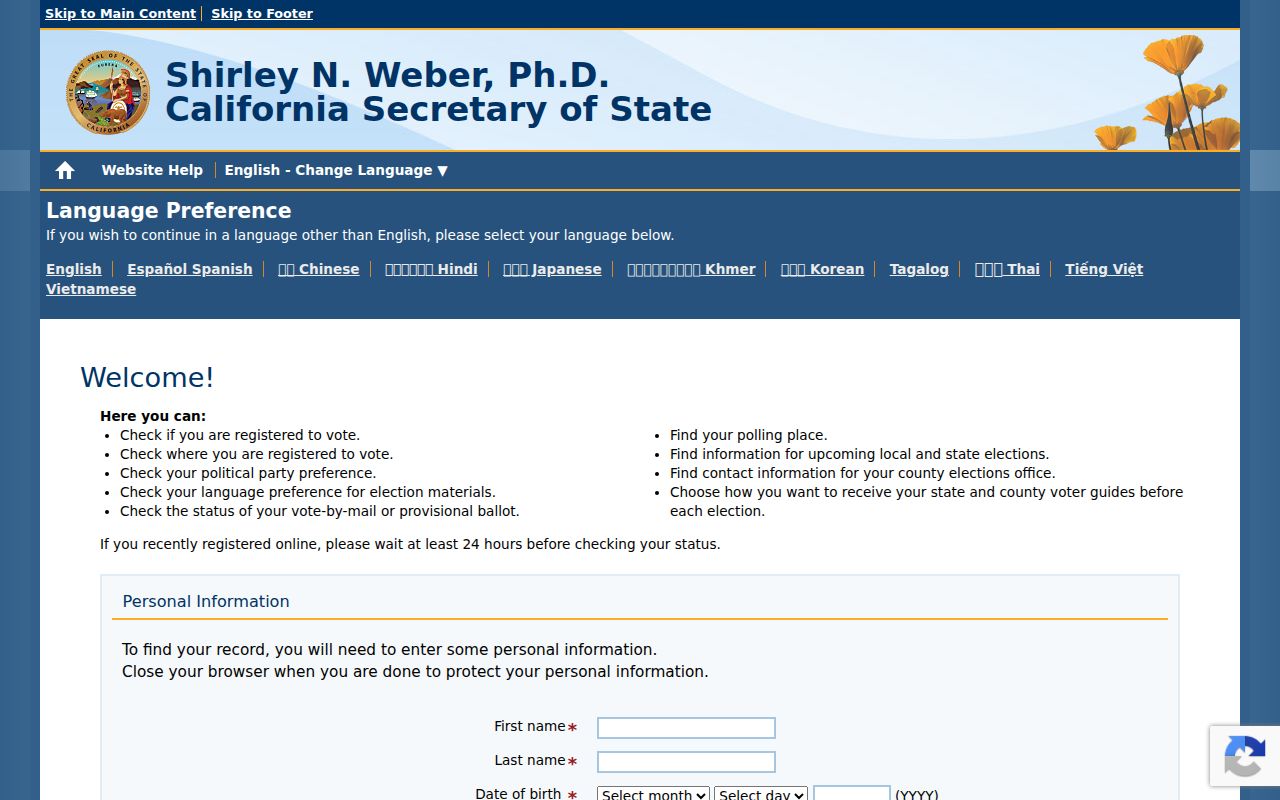
The self lookup covers only your own record. The Registrar answers authorized data and public-record questions in person, by mail, email, fax, or the county request portal. Historical poll books call for library or archive digging, since no exact countywide year inventory is published.
Riverside Vital Records Choices
Vital records in Riverside County split by office. Birth, death, and fetal-death records rest with Riverside University Health System Public Health. Marriage records, including confidential marriage, belong to the ACR County Clerk. CDPH provides statewide applications for birth, death, fetal death, marriage, and dissolution. No fixed genealogy period opens a certificate in California.
Two copy types exist. Health and Safety Code sections 103526 and 103526.5 draw the line between an authorized certified copy and a certified informational copy. The first can establish identity for an eligible requester. The second is marked to show it cannot. Family Code section 509 limits confidential marriage copies. Adoption records stay sealed. Original birth certificates open only through a statutory or court process. The Riverside County vital-records service lists the county application route and forms for a local event.
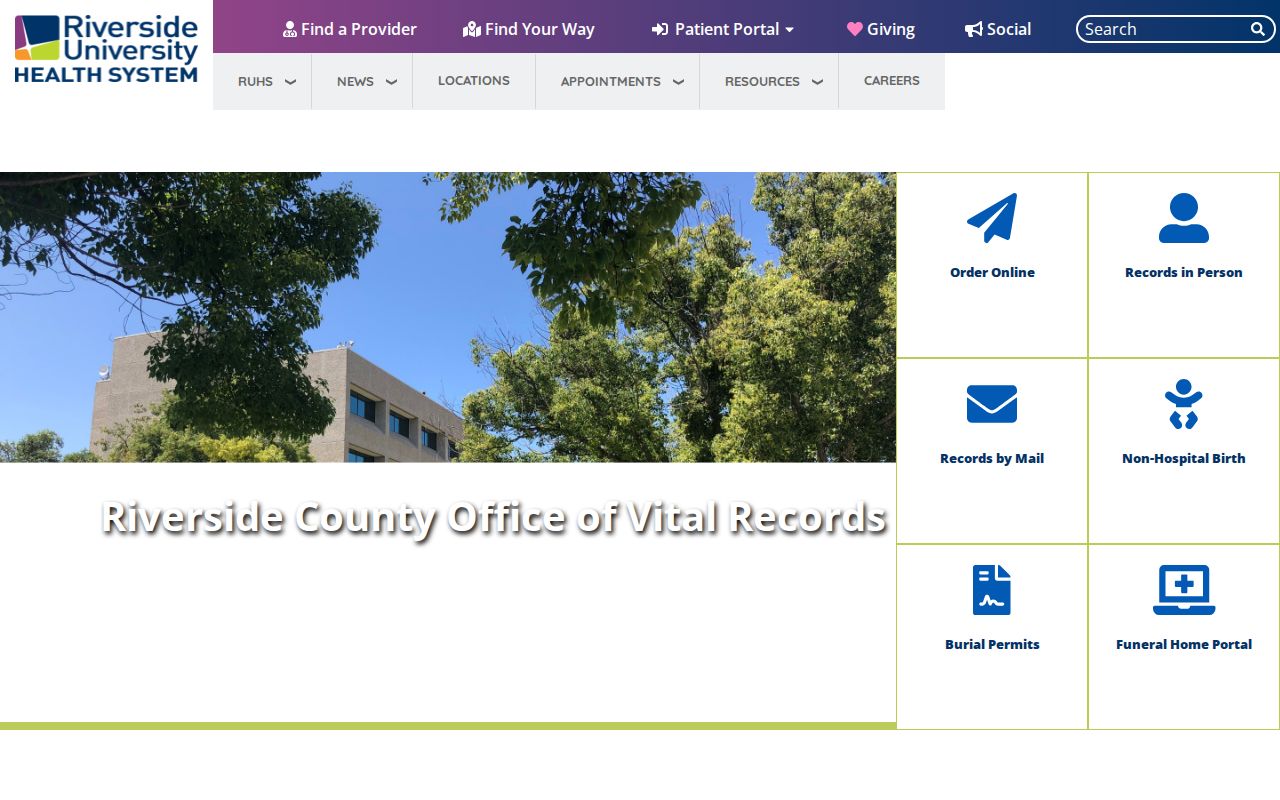
County mail forms go to the Riverside Office of Vital Records at P.O. Box 7600, Riverside, CA 92513, reachable at 951-358-5068. Authorized mail requests require a sworn statement with notarization. Riverside County's 2026 fees are $34 for a birth copy, $26 for a death copy, and $23 for fetal death. State-level CDPH prices differ: $31 birth, $26 death, $19 marriage, $18 dissolution, $23 fetal death, and $28 stillbirth.
- Use the county route for a Riverside event or CDPH for the statewide custodian.
- Use the accepted check or money-order method; do not mail cash to CDPH.
- Choose an informational copy when identity use is not required and an authorized request only when eligible.
Riverside Heir Records and Family Paths
Probate files beat name-only lists for an heir search. Recorded successor deeds help too. A Riverside Superior Court probate file can name a decedent, fiduciary, and petition. It can also list notices and heirs or beneficiaries in the filings. A later deed can show how an interest passed to a successor. Online probate coverage starts in July 1994. That start applies in most locations. Older material may need a clerk, archive, or request form.
Other family paths need their own records. An obituary links relatives to a place, but it proves no continuous occupancy. A former classmate may appear in a yearbook, newspaper, community archive, or historical directory. A birth-parent search must use California adoption-information, mutual-consent, or court channels. It cannot treat an original birth certificate as open. A business-owner question may draw on SOS filings and a county fictitious business name. It may also draw on a professional-license record. Unclaimed property is a clue, not a property-title record.
Keep the labels straight. Heir, fiduciary, grantor, grantee, directory occupant, and business agent are different roles. Match two identifiers, such as date and parcel or spouse and city, before merging names.
Riverside’s 1893 Records Boundary
Riverside County dates only to 1893. It was carved from San Bernardino and San Diego Counties. Deeds, court matters, and vital events from before that year may sit under a predecessor county. They may not sit in a Riverside index. ACR clerk indexing starts with county formation. The online recorder index goes back only to 1974. Gateway Riverside is the practical stop for older recorder books and grantor-grantee indexes.
The destroyed 1890 federal census makes the founding decade hard to rebuild. Researchers pair the 1880 predecessor-county census with 1893-forward deeds. They also add directories, voter or tax sources, newspapers, cemetery files, and the 1900 census. City of Riverside maps and Sanborn materials can pin down a street or structure. They work even without a person list. A blank result is often a coverage clue. It is not proof that a person or property never existed.
Note: Search both the modern county name and the predecessor county. Do this when a Riverside family or parcel predates 1893.
Twenty-Eight Riverside City Keepers
Riverside County holds 28 incorporated cities. None shares one records desk. A permit inside the City of Riverside sits with Community and Economic Development. An unincorporated parcel goes to Riverside County TLMA Building and Safety. Other incorporated cities keep their own planning, clerk, code, police, and public-works files. Check county GIS first. Confirm the situs jurisdiction before sending a request. The county's Census QuickFacts profile keeps that scale in view. Its population figures are context, not a resident list.
The City of Riverside property-research guide opens several doors. Permit files there are arranged by address. Public Works keeps tract maps and a street-name-change index. Museum of Riverside materials and Riverside Public Library local history add archival depth. Riverside County Library System spreads a 35-library, two-museum network across the county. Its depth shifts by branch and community. A permit file can name an applicant, owner, contractor, work description, and dates. Code complaint data may withhold complainant information.
City clerks take Public Records Act requests for minutes, ordinances, contracts, boards, and administrative files. Police reports stay with the responsible city department or Sheriff station. They remain subject to eligibility and redaction. Keep city, county, library, museum, and tribal boundaries visible in a Riverside residents directory search.
When Riverside Records Go Offline
Online access is one channel among several. The California Public Records Act, Government Code sections 7920.000 through 7931.000, lets any person request identifiable records without stating a purpose, and an agency need not create a record or answer an open-ended question. An agency ordinarily answers within ten calendar days. A 14-day extension is possible.
Match the method to the keeper. A records counter, terminal, phone, mail form, library catalog, archive inquiry, or request process can all work. ACR accepts online, in-person, and mail workflows, while courts rely on the account portal, clerk forms, courthouse staff, and archives. Cities may use an agenda portal, clerk email, a counter, a city system, or county NextRequest. Ask for electronic files and segregable portions.
The California public-record request instructions show the state route when an agency's normal index does not answer the question.
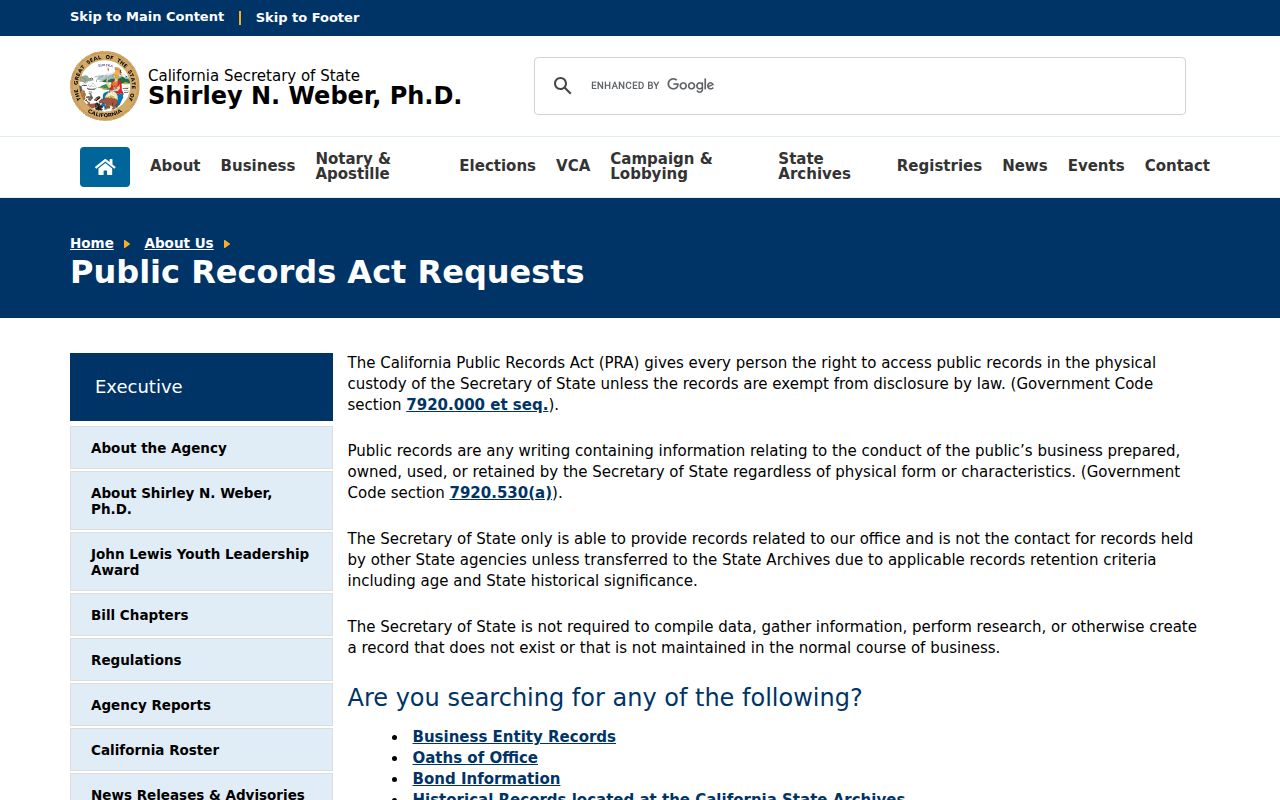
Use that same route to request inspection, an electronic copy, or a rolling production, naming the record type, date range, parcel or case number, and custodian. Inspection is normally free, though copies may cost direct duplication.
| Source type | Strength | Best safeguard |
|---|---|---|
| Official county, court, city, or state record | Defined keeper and access rule | Read the coverage date and verify with the custodian. |
| Commercial people-finder category | Compiled leads that may merge names | Use only as a lead, then return to the official record. |
| Library, museum, or archive collection | Historical context and local publications | Ask about holdings, gaps, handling, and date. |
Note: A missing online page can reflect a date cutoff, a sealed file, an archive transfer, or a Riverside records keeper that never offered a web index.
Riverside Sheriff Resident Records
The Riverside County Sheriff Inmate Information System is a custody lookup, not a residents directory for the county. Search it by last name, first name, or booking number. A match can show booking number and facility. It may also list booking or release information, court data, and charges or bail where publishable. Coverage stops at county custody. State custody belongs to the California CDCR locator. The California DOJ Megan's Law search runs its own name, map, and address modes with statutory restrictions.
Treat a booking entry as a custody fact tied to that moment, and confirm disposition with the court. Incident reports come from whichever police or Sheriff Records Bureau handled the case. Expect a request to ask for date and location, report number, and involved-party identity. It may also want your relationship or authorization, identification, and a delivery method. Victim, juvenile, medical, and investigative details may be withheld or redacted.
The Riverside County Sheriff public-services site supplies the agency context behind these custody and records channels.
Riverside Sheriff points to the office, not the household.
Riverside Resident Search Terms
Riverside records lean on compact labels that can trip up a first resident lookup. Learning what each term actually covers keeps a residents directory, index, parcel entry, and resident clue inside its proper lane.
- Roll
- A list maintained for a defined purpose, such as assessment or voter registration. It does not list every person in a county.
- Index
- A finding aid for a record, often showing a party, date, type, and number. It is not the full image or proof of current residence.
- Criss-cross directory
- A reverse directory that starts with a street address and may name a listed occupant or phone subscriber for that publication year.
- Parcel
- An assessment unit identified by an APN. A parcel is land, not a household, and an APN does not encode all residents.
More labels come up in a Riverside lookup. A situs address ties a parcel to its street, and a legal description spells out the land in deed terms. Grantor and grantee name seller and buyer. A docket tracks a court case. Copies run certified or informational, and a name in an index may be a party to a filing, a historical publication entry, or a voter checking status, never proof that those categories overlap.
Riverside Resident Directories Through Time
No countywide directory run exists. Publishers chased urban markets and telephone exchanges, so coverage stopped wherever the wires did. Name the community first. Choices include Riverside, Corona, Hemet-San Jacinto, Palm Springs and the Coachella Valley, Banning-Beaumont, and the southwest county. Riverside Public Library, the Museum of Riverside, RCLS, and UC Riverside Special Collections each shelve different years and titles.
The holdings reach beyond directories. Newspapers, photographs, maps, subject files, and Sanborn fire-insurance maps round out the shelves. Sanborn editions for Riverside include 1887, 1891, 1895, 1908, 1951, and 1952. The library keeps runs on microfilm. The museum holds originals by appointment. A typical entry lists a name, spouse, occupation, street address, and an owner-or-renter mark. A reverse section works from address back to occupant.
Full runs are not online. Search titles like Riverside city directory, Polk's Riverside, telephone directory, and criss-cross. Then ask whether the year you need is bound, on microfilm, loose, or held at another institution. Pair each hit with other evidence. Census, deed, permit, obituary, and probate records confirm what a directory only sketches. The Riverside Directory Book follows these collections further.
Note: A directory captures one publication cycle. A blank year can mean omission, nonpublication, rural delivery, annexation, or a street-name change.