
Finding Riverside Resident Records
Riverside County records are divided by question. An assessor parcel can anchor an address, a deed can identify a transfer party, and a city directory can place a past household. A court index shows a party and case, not a complete household. A voter service confirms the voter’s own registration, while a library shelf may preserve a past neighbor.
Use the strongest starting key, then move to a second source. A name can join unrelated people. An address can point to a parcel without showing every occupant. A sound Riverside residents directory workflow keeps those limits visible.
- Start with an address or APN in RivCoView when property is the clue.
- Search the ACR index by party, document number, type, date, or map reference.
- Use the Superior Court portal for a case or party trail; coverage varies by courthouse and case type.
- Check My Voter Status only for the voter’s own record, or use the file process for a permitted purpose.
- For older households, use directories, newspapers, maps, probate, and predecessor-county records.
Where Riverside Resident Records Live
The Riverside County Assessor-County Clerk-Recorder, usually called ACR, is the main starting office for parcels, recorded instruments, marriages, and fictitious business names. The Superior Court keeps case and probate material. The Registrar of Voters handles election records under purpose limits. City clerks, building departments, police agencies, libraries, museums, and county departments fill in the gaps created by a county with 28 incorporated cities and large unincorporated areas.
Riverside County ACR
Assessor facts, recorded documents, clerk filings, marriage records, and copy orders.
Riverside Superior Court
Civil, criminal, family law, probate, and traffic case access with local request forms.
Riverside Registrar of Voters
Election services, voter-file guidance, voter requests, and public-record channels.
City and Library Desks
Permits, tract maps, local history, newspapers, directories, photographs, and subject files.
Each office answers a narrower question. For a street-by-street address trail, begin with the parcel and keep the APN or legal description as the record moves between custodians.
Riverside Property Records Offline
RivCoView accepts a street number and name or an assessor parcel number. Its map can show parcels, boundaries, sales, permits, assessment and tax panels, census information, and school layers. The online search does not offer an owner-name search. Under Revenue and Taxation Code section 408, ownership is available at ACR public-service-office computers using an address or APN.
A situs address is the land’s physical location. An owner mailing address is where tax notices go, and the two can differ. Neither proves that every person at the parcel lives there. Carry the APN, tract or lot, and legal description into the recorder index.
| RivCoView control | Type | Use |
|---|---|---|
| Property Address | Text, alternative | Street number and name; omit city or suffix when needed. |
| Assessor Parcel Number | Text, alternative | Use the APN to hold the parcel across maps and records. |
| Map search | Pan, zoom, click | Select a parcel and inspect adjacent parcels or jurisdiction layers. |
| Layers | Map control | Parcels, boundaries, assessment, sales, permits, census, or school information. |
The ACR recorder index offers name, document number, document type, map type and book/page, and advanced modes. Individuals use Last First MI. The web recorder index begins January 1, 1974, clerk documents begin January 1, 1893, and older recorder books are researched at Gateway Riverside.
The index is free, but copies are ordered. Research notes list $8 for the first regular-copy page, $1 for each added page, $2 for certification, and a 2.15% online card fee. In-person orders may be same day. Mail requests need the type or title, full parties, estimated date, and APN. Online orders are mailed after payment.
For a street, use the Riverside street directory path.
Riverside Current Resident Directory Sources
Several Riverside sources look like directories, but each lists a different slice of the population. These sources separate parcel evidence, recorded-party evidence, court parties, a voter’s own registration, and local administrative or historical files. A source can be useful without being a complete list of current residents.
| Source | What it can show | Keeper | Access |
|---|---|---|---|
| RivCoView and assessment facts | Parcel, situs, values, sales, permits, and mapped context | ACR and County GIS | Online; owner at ACR office computers |
| Official Records index | Parties to deeds, liens, maps, notices, and other filings | ACR Recorder | Free index; paid copies; Gateway for older recorder books |
| Public court access | Case party, case type, filing trail, register, and calendar | Riverside Superior Court | Account, name credits, case-number documents, clerk requests |
| My Voter Status | The voter’s own registration, ballot, precinct, and district information | California Secretary of State | Free identity-gated self lookup |
| City, library, and museum files | Permits, staff or board records, directories, newspapers, maps, and photographs | City or local-history keeper | Portal, counter, catalog, appointment, or records request |
Neighborhood groups may publish officers, contacts, and events, but a public contact page is not a private membership roster. A city staff directory identifies a public office, not everyone who lives nearby. The best match comes from combining the source’s stated scope with the question being asked.
Note: A directory entry may show a legal connection while leaving ordinary household members outside the record.
Riverside Court Records Search
Riverside Superior Court handles civil, criminal, family law, probate, and traffic matters. No general statewide trial-court party index replaces the county portal. Online starting points vary: Riverside civil reaches October 1991, felony cases January 1990, family law in most locations April 1992, and probate in most locations July 1994. Other courthouses have different cutoffs.
The portal requires an account. A person or organization name search uses paid credits; a register or document search needs a case number. Results can show case number, caption, type, filing date, status, parties, courthouse, register entries, and hearing details. Online information is not the official court record.
- Name credits range from a one-name purchase to a 30-day unlimited self-service option; the court also offers a court-conducted name search.
- Documents and register entries may be downloaded when allowed, with the published page-fee cap and copy rules.
- RI-MC002 requests a records search by location, case type, years, and identifying details.
- RI-MC011 requests regular or certified copies by case number, title, and document details.
- Clerk counters, courthouse terminals, mail requests, and archive inquiries remain fallback channels when a case is absent online.
Sealed, juvenile, adoption, expunged, and much family material has special limits. Probate and a later recorded deed answer different parts of an heir question.
A Riverside Voter Lookup Is Personal
My Voter Status is a self-service check, not a public reverse directory. It asks for first name, last name, date of birth, and a California driver license or identification number, or last four Social Security number digits as directed. A match can return the voter’s status, party preference, available address information, precinct, district, polling or vote-center details, and ballot information.
Elections Code section 2194 limits voter-file release to election, scholarly, journalistic, political, or governmental purposes. A statewide file application is listed at $100. A specific-voter request for up to ten people requires full name, date of birth, county, and residence address. Applications state the purpose, fields, geography, safeguards, delivery, and distribution controls. Check the Registrar and Secretary of State instructions before treating a voter-file request as a resident lookup.
The California My Voter Status service demonstrates why the identity fields belong to the voter rather than a casual searcher.
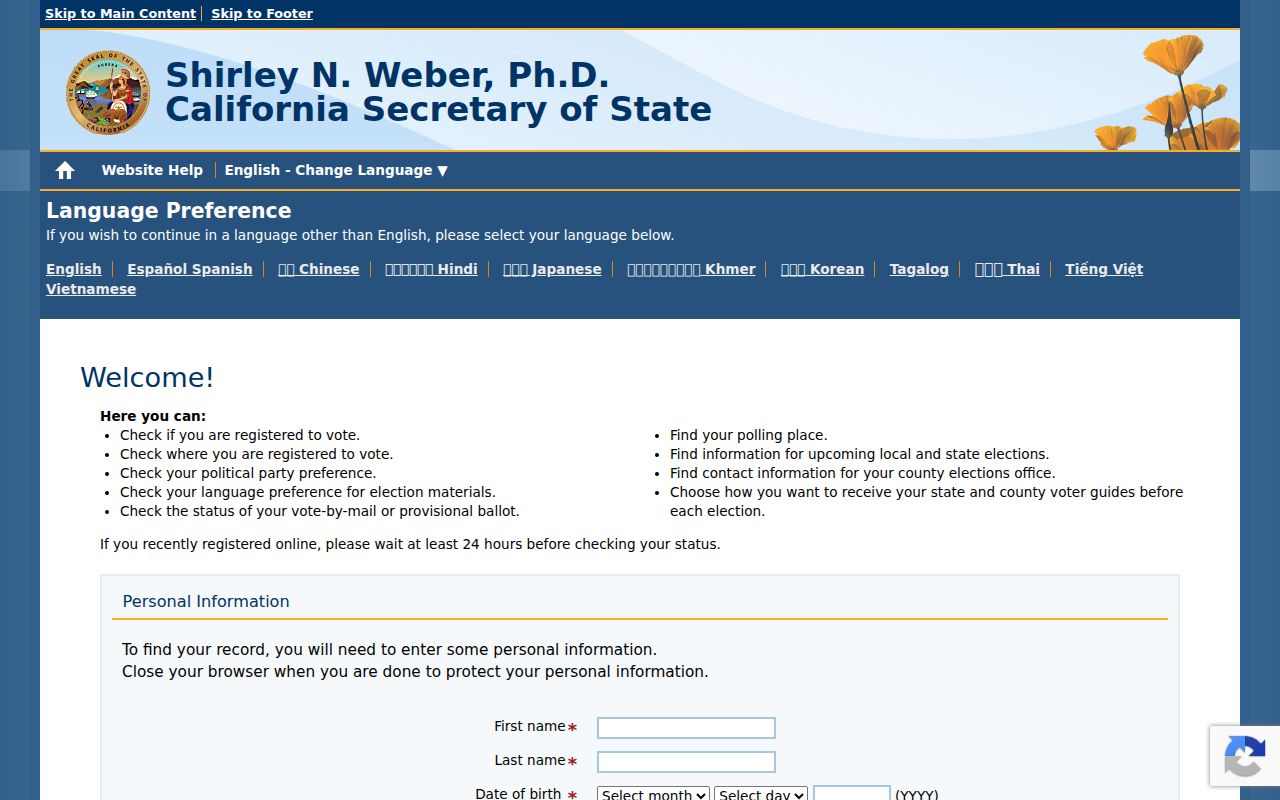
The self lookup checks one’s own record. The Registrar handles authorized data and public-record questions verbally, by mail, email, fax, personal delivery, or the county request portal. Historical poll books require library or archive research, and no exact countywide year inventory is published.
Riverside Vital Records Choices
Riverside University Health System Public Health Office of Vital Records handles county birth, death, and fetal-death records. ACR County Clerk handles marriage records, including confidential marriage. CDPH provides statewide applications for birth, death, fetal death, marriage, and dissolution. California does not simply open a certificate after a fixed genealogy period.
Health and Safety Code sections 103526 and 103526.5 separate an authorized certified copy from a certified informational copy. The first can establish identity for an eligible requester; the second is marked that it cannot. Confidential marriage copies are limited under Family Code section 509. Adoption records and original birth certificates remain sealed unless a statutory or court process applies.
The Riverside County vital-records service lists the county application route and forms for a local event.
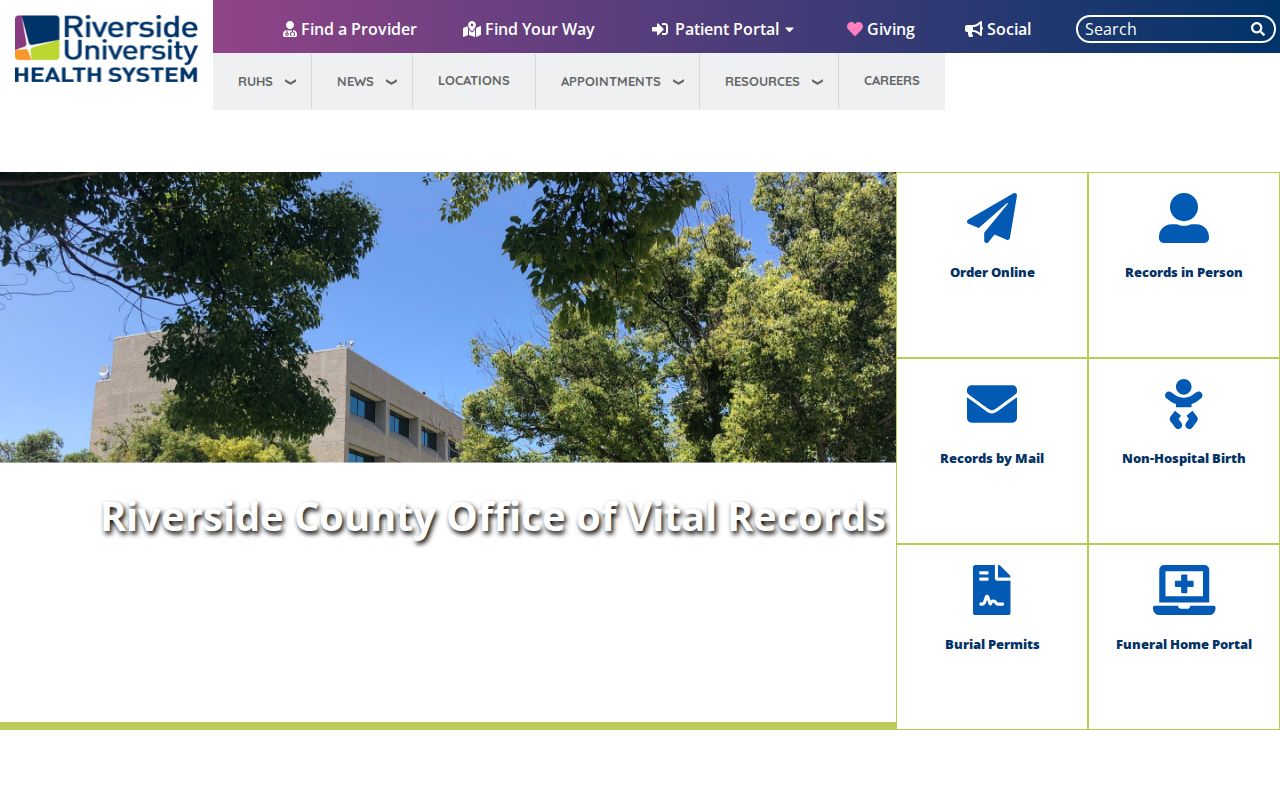
County mail forms use the Riverside Office of Vital Records, P.O. Box 7600, Riverside, CA 92513, and 951-358-5068. Authorized mail requests need the sworn statement and notarization. The 2026 county fees are $34 birth, $26 death, and $23 fetal death. CDPH lists $31 birth, $26 death, $19 marriage, $18 dissolution, $23 fetal death, and $28 stillbirth.
- Use the county route for a Riverside event or CDPH for the statewide custodian.
- Use the accepted check or money-order method; do not mail cash to CDPH.
- Choose an informational copy when identity use is not required and an authorized request only when eligible.
Riverside Heir Records and Family Paths
Probate and recorded successor deeds give an heir search a stronger official route than a name-only list. A Riverside Superior Court probate file can identify a decedent, fiduciary, petition, notices, and heirs or beneficiaries in filings. A later deed can show how an interest moved to a successor. The court’s online probate coverage begins in most locations in July 1994; older material may require a clerk, archive, or request form.
Other family paths need their own records. An obituary can connect relatives and a place, but it is not proof of continuous occupancy. A former classmate may be found in a yearbook, newspaper, community archive, or historical directory. A birth-parent search must use California adoption-information, mutual-consent, or court channels rather than treating an original birth certificate as open. A business-owner question may use SOS filings, a county fictitious business name, and a professional-license record. A separate unclaimed-property clue can be useful, but it is not a property-title record.
Keep roles clear: heir, fiduciary, grantor, grantee, directory occupant, and business agent are different labels. Match two identifiers, such as date and parcel or spouse and city, before merging names.
Riverside’s 1893 Records Boundary
Riverside County was created in 1893 from portions of San Bernardino and San Diego Counties. Earlier deeds, court matters, and vital events can therefore sit under a predecessor county rather than a Riverside index. ACR clerk indexing begins with county formation, while the online recorder index begins in 1974. Gateway Riverside is the practical older-record stop for recorder books and grantor-grantee indexes.
The destroyed 1890 federal population schedule makes the founding decade harder to reconstruct. Pair the 1880 predecessor-county census with 1893-forward deeds, directories, voter or tax sources, newspapers, cemetery files, and the 1900 census. City of Riverside maps and Sanborn materials can establish a street or structure even when a person list is missing. A missing online result is often a coverage clue, not proof that the person or property did not exist.
Note: Search both the modern county name and the predecessor county when a Riverside family or parcel predates 1893.
Twenty-Eight Riverside City Keepers
Riverside County’s 28 incorporated cities do not share one permit or police records desk. A City of Riverside permit belongs with Community and Economic Development, while an unincorporated parcel goes to Riverside County TLMA Building and Safety. Other incorporated cities keep their own planning, clerk, code, police, and public-works files. Identify the situs jurisdiction in county GIS before sending a request. The county's Census QuickFacts profile helps keep the scale of that geography in view, but its population figures are context, not a resident list.
The City of Riverside property-research guide points to address-arranged permit files, Public Works tract maps and its street-name-change index, Museum of Riverside materials, and Riverside Public Library local history. Riverside County Library System (RCLS) adds a 35-library, two-museum network, with depth that changes by branch and community. Permit files may name an applicant, owner, contractor, work description, and dates; code complaint data can have withheld complainant information.
City clerks accept Public Records Act requests for minutes, ordinances, contracts, boards, and administrative files. Police reports stay with the responsible city department or Sheriff station, subject to eligibility and redaction. Keep city, county, library, museum, and tribal boundaries visible in a Riverside residents directory search.
When Riverside Records Go Offline
Online access is only one channel. The California Public Records Act, Government Code sections 7920.000 through 7931.000, permits any person to request identifiable records without stating a purpose. An agency ordinarily responds within ten calendar days, with a possible 14-day extension. It need not create a record or answer an open-ended question.
Use the counter, terminal, phone, mail form, library catalog, archive inquiry, or request process that fits the keeper. ACR accepts online, in-person, and mail workflows. Courts use the account portal, clerk forms, courthouse staff, and archives. Cities may use an agenda portal, clerk email, counter, city system, or county NextRequest. Ask for electronic files and segregable portions.
The California public-record request instructions show the state route when an agency’s normal index does not answer the question.
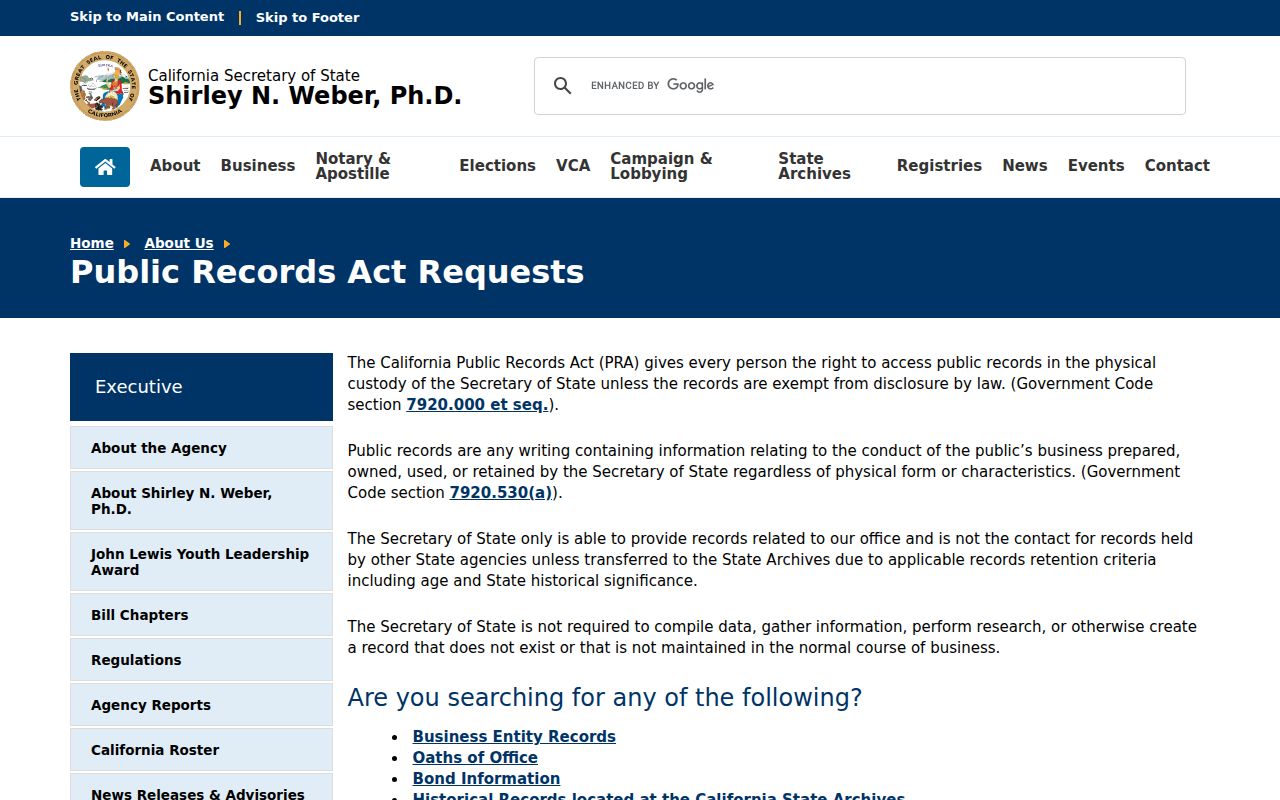
Request inspection, an electronic copy, or a rolling production. Inspection is normally free; copies may cost direct duplication. Name the type, date range, parcel or case number, and custodian.
| Source type | Strength | Best safeguard |
|---|---|---|
| Official county, court, city, or state record | Defined keeper and access rule | Read the coverage date and verify with the custodian. |
| Commercial people-finder category | Compiled leads that may merge names | Use only as a lead, then return to the official record. |
| Library, museum, or archive collection | Historical context and local publications | Ask about holdings, gaps, handling, and date. |
Note: A missing online page can reflect a date cutoff, a sealed file, an archive transfer, or a keeper that never offered a web index.
Riverside Sheriff Resident Records
The Riverside County Sheriff Inmate Information System is a custody lookup, not a general residents directory. It uses last name, first name, and/or booking number. A result may show booking number, facility, booking or release information, court data, and charges or bail where publishable. It covers county custody only. The California CDCR locator covers state custody, and the California DOJ Megan’s Law search has its own name, map, and address modes and statutory restrictions.
Use a booking entry as a time-specific custody fact and confirm disposition through the court. Incident reports follow the responsible police or Sheriff Records Bureau. A request may need the date and location, report number, involved-party identity, relationship or authorization, identification, and delivery method. Victim, juvenile, medical, and investigative details may be withheld or redacted.
The Riverside County Sheriff public-services site gives the agency context behind the custody and records channels.
The result can identify the responsible office, but it cannot establish a person’s home or household.
Riverside Resident Search Terms
Riverside records use short labels that can mislead a first search. These definitions keep a directory, index, parcel, and resident clue in their proper scope.
- Roll
- A list maintained for a defined purpose, such as assessment or voter registration. It does not list every person in a county.
- Index
- A finding aid for a record, often showing a party, date, type, and number. It is not the full image or proof of current residence.
- Criss-cross directory
- A reverse directory that starts with a street address and may name a listed occupant or phone subscriber for that publication year.
- Parcel
- An assessment unit identified by an APN. A parcel is land, not a household, and an APN does not encode all residents.
Other useful terms include situs address, legal description, grantor, grantee, docket, certified copy, and informational copy. Define each term from the record keeper’s use. A name in an index can be a party to a filing, a person in a historical publication, or a voter checking their own status, with no claim that the categories are the same.
Riverside Resident Directories Through Time
No single countywide city-directory run exists. Publishers served urban markets and telephone exchanges, so name the community first: Riverside, Corona, Hemet-San Jacinto, Palm Springs and Coachella Valley, Banning-Beaumont, or southwest county. Riverside Public Library, Museum of Riverside, RCLS, and UC Riverside Special Collections have different shelves.
Riverside materials include directories, newspapers, photographs, maps, Sanborn maps, and subject files. Documented Sanborn editions include 1887, 1891, 1895, 1908, 1951, and 1952. The library has microfilm; the museum holds originals by appointment. An entry may show a name, spouse, occupation, address, and owner or renter mark. A reverse section moves from address to occupant.
Exact runs are not fully online. Search titles such as Riverside city directory, Polk’s Riverside, telephone directory, and criss-cross, then ask whether the year is bound, on microfilm, loose, or held elsewhere. Pair it with census, deed, permit, obituary, or probate evidence. The Riverside Directory Book follows the collections.
Note: A directory records a publication-cycle snapshot, so a blank year can mean omission, nonpublication, rural delivery, annexation, or a street-name change.